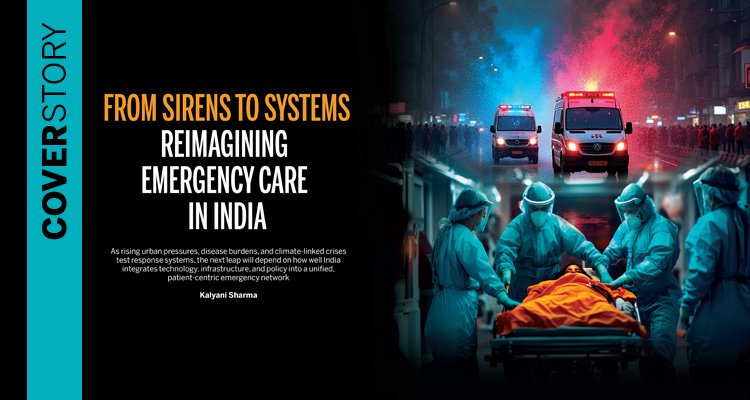
India’s emergency care landscape is undergoing a fundamental shift from episodic, hospital-based intervention to a continuous, system-driven response.
As Dr Sarbari Swaika, Professor and HOD-Department of Emergency Medicine, DPU Super Specialty Hospital, Pune explains, “Emergency care in India is undergoing a profound transformation. Traditionally perceived as a hospital-based, reactive service confined to the “casualty,” it is now evolving into a dynamic, system-oriented discipline that emphasises timeliness, coordination, and continuity of care.”
This shift is visible on the ground. Pre-hospital care is gaining strength, and early intervention is becoming critical.
Dr Himanshu Dewan, Group Director-Critical Care Medicine, Sarvodaya Healthcare highlights how this transformation is already saving time and lives, “Emergency care is becoming more proactive, rather than merely reactive. Currently, emergency units have resources like ventilators and other advanced machines at their disposal with the added support of well-organised emergency medicine staff. Through technology, there is a more efficient collaboration between hospital emergency rooms and pre-hospital emergency personnel. For example, an ambulance technicain can send an ECG of an heart attack patient or convey the symptoms suggestive of stroke to emergency and they can start the treatment at pre hospital level (on the way to hospital) saving crucial time.”
The emphasis is no longer just on treatment but on when and how quickly it begins.
The role of hospitals as central anchors in emergency response is also gaining prominence.
Urvaksh Bhote, COO, Ruby Hall Clinic explains, “Hospitals are evolving beyond passive care centres into active emergency response hubs. Large institutions are integrating advanced emergency departments with triage systems, critical care units, and dedicated trauma protocols. This hospital-centric approach ensures that once a patient reaches the facility, diagnosis and intervention begin immediately reducing mortality in critical cases like cardiac events, strokes, or trauma.”
This underscores a critical shift—while technology and logistics are expanding the ecosystem, hospitals continue to remain the core nodes where definitive care is delivered.
The ecosystem challenge: Fragmentation and inequity
Despite this evolution, India’s emergency response system remains fragmented.
Gaurav Karambelkar, Senior Manager, Sumeet SSG underscores the core issue. He highlights, “The biggest gap is not having a cohesive emergency response ecosystem at all. We have various individual emergency care programs running simultaneously throughout the country – which are doing an adequate job, no doubt – but all of them operate in their own individual silos. A comprehensive, cohesive national framework is urgently required. Uneven geographical coverage is another big gap. While urban areas have multiple avenues of emergency care, rural and semi-urban areas face significant deficits in timely access, not to mention availability of required resources.”
Quick-commerce: Disruptor or enabler?
A new and unexpected player has entered the emergency ecosystem—quick-commerce.
These platforms promise rapid delivery of medicines and medical essentials, particularly in urban areas.
Dr Chandra sees their potential, “Quick-commerce and hyperlocal delivery platforms can play a valuable supplementary role in emergency care, particularly in bridging last-mile gaps. These platforms can enable rapid delivery of essential medicines, medical devices, or first-aid kits during emergencies, especially in congested urban settings. Importantly, these platforms should complement—not replace—formal emergency systems, functioning as an auxiliary support layer that improves accessibility and speed without compromising clinical oversight.”
However, experts are cautious about their role.
Satish Kumar Singh, Founder, MY LYF CARE draws a clear boundary, “These platforms have the potential to significantly enhance emergency response, but their role must be clearly defined. They should function as a last-mile logistics layer, not as clinical decision-makers.”
Similarly, Dr Dewan stresses the limits of logistics in healthcare. He stresses, “Difficult to draw useful inference from e-commerce as these platforms provide objects in a short time, and healthcare needs to provide expertise at the point of need, with time as a crucial factor.”
The consensus is clear—quick commerce can support emergency care, but not substitute it. Integration with clinical systems and strict regulatory oversight will be critical.
Persistent bottlenecks: Time lost is life lost
Even as innovation accelerates, several bottlenecks continue to hinder emergency response.
Traffic congestion remains a major barrier. Dr Latheef notes, “Traffic jam, absence of synchronised communication systems, and shortage of trained manpower are some of the factors that usually lead to delays in emergency care. Ambulances in most occasions have trouble beating traffic jams and this means that it wastes vital time.”
Communication gaps further slow the system. Dr (Col) Chakraberty highlights, “Emergency services don’t respond as quickly when they can’t talk to each other.”
Workforce shortages are another critical concern. As Dr Dewan points out, “This gap is further increased by lack of traiined emergency professioinal and structured healthcare facilities.”
In many cases, delays begin even before the system is activated. Singh observes, “One of the most underestimated bottlenecks is delayed incident recognition. Many emergencies are not identified or acted upon quickly enough, which leads to lost critical time even before the system is activated.”
These challenges underline a simple truth: speed in emergency care depends as much on systems as on infrastructure.
The integration imperative: Towards a unified national framework
There is near-universal agreement among experts on one key solution—a unified, integrated emergency response system.
Dr Chakraberty emphasises the need clearly, “India really needs a single national emergency response plan to make sure that things happen quickly and consistently across the country.”
Karambelkar reinforces this with a global perspective, “India would benefit significantly from a unified and interoperable national emergency response framework along the lines of 911 in the USA, 999 in the UK, 112 in the EU, 000 in Australia.”
Public–private partnerships will be central to building this ecosystem. Dr Vunnam notes, “The public sector can provide policy direction, standardisation, and scale, while the private sector can bring in technology, innovation, infrastructure, and operational efficiency.”
The goal is not just integration—but seamless coordination across every stage of emergency care.
The road ahead: Building a resilient, responsive system
India stands at a critical juncture in its emergency care journey.
The vision, as Dr Swaika articulates, is clear, “Emergency care in India is being redefined not merely as a service, but as a time-sensitive, system-integrated, and outcome-oriented domain of healthcare.”
Achieving this vision will require sustained investment in infrastructure, workforce training, technology, and governance. It will also demand a shift in mindset, recognising emergency care as a foundational pillar of the healthcare system.
Because ultimately, in emergency medicine, every minute matters and every improvement in response can mean the difference between life and death.
credit Goes to @expressindia.com


